
Online store development
Online store development should connect a clear product offering, straightforward purchasing and efficient order processing. We design and develop online stores tailored to your products, customers and the way your business operates.
DesignJust4You · Digital solutions for business
Online store development: examples of our work
Our projects include the Identitet, Princip, LIPO Cosmetics and Delishop online stores. These examples show different approaches to presenting a retail brand and catalogue. Look at the content layout, product highlights and brand presentation, then explain in your enquiry what you like and what should be different for your catalogue.

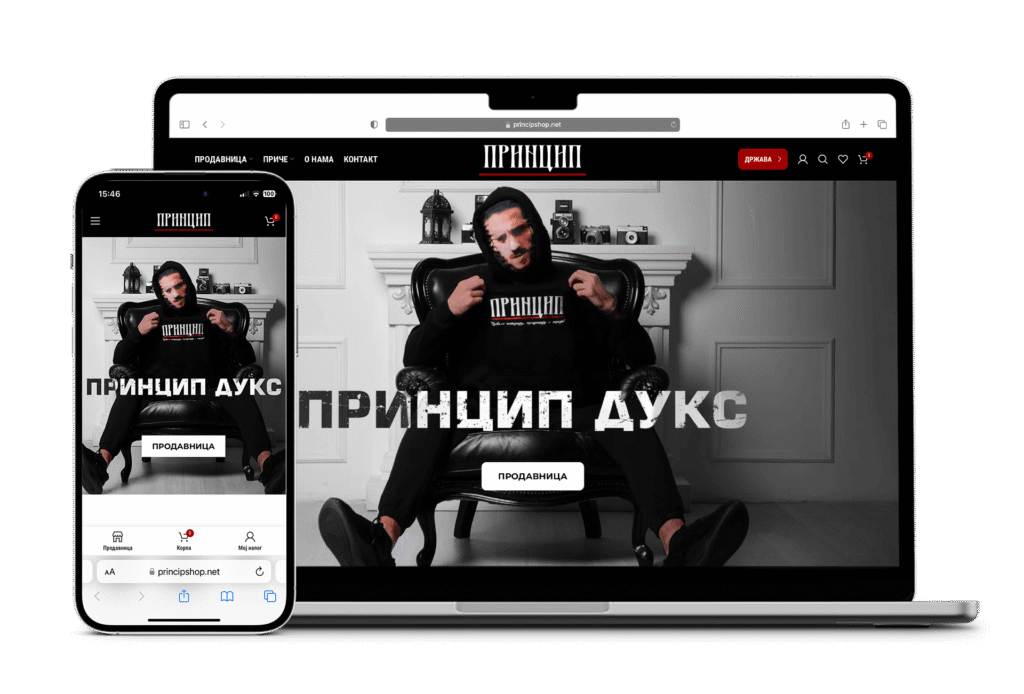


Online store development starts with your specific product range. Selling clothing, spare parts and digital products requires different information and purchasing steps. Before choosing the look, we therefore check what customers need to know and how your team processes an order. Find more examples in our website portfolio.
From catalogue to completed order
Customers need clear categories, product information, available options and an understandable next step. We work with your team to plan the catalogue structure, product page content, shopping cart and ordering process. We adapt the display for phones and computers.
On the administration side, we agree on how products, categories and orders will be managed. Features such as product variants, filters, coupons, customer accounts and multiple languages are included in the specification according to the store's needs.
What does store planning include?
Catalogue
Number of products, categories, variants and product data.
Design and content
Presenting your range, photography, descriptions and important customer information.
Ordering
Shopping cart, delivery details, confirmation and order statuses.
Payment and delivery
Selection of methods and integration of supported services.
Administration
Product entry, order processing and employee access.
SEO foundations
Category structure, titles, descriptions and indexing of public pages.
Connecting your store to an ERP
If you already manage products and stock in business software, we can plan how to exchange that data with the store. We agree on which system determines price and availability, how orders enter the records and how cancellations or changes are handled.
We check the possibilities through the software provider's documentation and support. You can find more about this part of the project on our API integrations and business automation page.
A B2B store for business customers
Wholesale businesses may need partner sign-in, individual price lists, different purchasing terms and bulk ordering. We specify these features separately, together with user roles and connections to the business system. Where needed, we develop a web application or partner portal.
Online store development: pricing
Our Premium website development package, with a shopping cart and payment integration, starts at 1.090 €. The final quote depends on the number and structure of products, design, content migration and additional features. See the package scope on our website development – pricing and packages page.
ERP connections, individual B2B terms and other custom development are estimated according to your requirements. Payment service fees, licences, hosting and maintenance are clarified in the quote.
How do we launch your store?
- We review the catalogue, target customers and order processing workflow.
- We agree on the structure, design and features of the first version.
- We build the store and add or migrate content within the agreed scope.
- We check test purchases, payment, delivery and administration.
- We prepare the launch, training and support plan.
Online store development and SEO structure
To help people find products, a clear category structure and useful product pages matter. We agree on category names, filters, product descriptions and URLs that should be accessible to search engines. We pay particular attention to product variants and filter combinations so visitors and search engines do not encounter many near-identical pages.
Information about pricing, availability and purchasing terms should be consistent wherever it appears. We plan product data and the site structure in line with Google's guidelines for e-commerce websites. Eligibility for additional search appearances also depends on meeting the rules of the specific Google service.
When migrating an existing store, we review old URLs and prepare relevant redirects. We link important categories from the navigation, and related products where this helps customers. For ongoing content work and organic visibility, see our website SEO optimization service.
DesignJust4You / Project plan
From catalogue to online order
- 1Catalogue
Products and categories
- 2Purchase
Cart and payment
- 3Connection
Stock and delivery
- 4Checks
Test purchase and launch
We agree on scope, timing and support according to your project.
How do you compare two store development quotes?
Compare the same items: the number of products and how they are entered, variants, design customization, payment methods, delivery, training and support. Ask the quote to distinguish one-off development from recurring costs. Identify integrations that depend on other providers. A lower starting price does not mean the same scope of work, so check what is included, what costs extra and which responsibilities belong to your team. Online store development should have clear project boundaries before work starts.
What should you prepare before building an online store?
Prepare a sample catalogue with a few typical products. For each one, provide a name, product code, category, description, price, availability and photos. If there are sizes, colours or pack sizes, show how the variants differ. One well-prepared example often reveals missing data sooner than a large list of products without a clear structure.
Online store development is easier when it is clear where data is maintained. If you change prices in business software and product descriptions on the website, document this in advance. The agreement also identifies who is responsible for checking the imported catalogue. Product count alone is not enough for an estimate: data quality, the number of variants and the way photos are transferred also matter.
What information do customers need on a product page?
The description should answer questions about the product's purpose, dimensions, material, compatibility or other important features. Use specific information and photos showing what you sell. Separate variant selection from quantity and clearly display the available options. If dispatch times differ by product, that information should be visible before an order is placed.
When preparing content, also check the terminology your customers use. Categories should make sense to someone visiting the store for the first time. A good name and a useful description make choosing easier, while unnecessary keyword repetition can make reading harder. The owner of the product offering checks photos, text and specifications before publication.
How do we agree on payment and delivery?
Specify the payment methods you want and whether you already work with a bank or payment service. Integration options depend on available documentation, the provider's terms and support from the chosen platform. Service activation and its fees are clarified separately from development itself. Not every method is available for every market or business model.
For delivery, prepare the delivery areas, pricing rules and any exceptions. We check how the cart behaves for different addresses and product combinations. Customers should understand the total amount and the next step before submitting an order. Online store development therefore includes agreeing on these rules, as well as adding a purchase button.
What is checked before launch?
A test purchase should cover the entire journey from a category to order confirmation. Check that the selected variant stays in the cart, that the quantity can be changed and that delivery costs are clear. Pay particular attention to the phone display, text readability, form fields and messages when information is missing.
- The product, variant and final amount match the customer's selection.
- Successful and failed payments produce an understandable message.
- Confirmation reaches the agreed destinations with the correct order details.
- The administration area displays the status and information needed for processing.
- Important contact links and purchasing terms pages are accessible.
Online store development concludes with a check of the agreed scope. Record larger features that are outside the first version as a later phase. This keeps the start of sales from depending on every future idea, while retaining a clear development plan. It is useful to agree on testing methods, responsible people and acceptance criteria before publication.
What does moving from an existing store involve?
Migration requires a review of the data that can be exported and the information you want to retain. Alongside products, consider categories, photos, important page URLs and the agreed scope of order history. Data transfer should first be checked on a sample. Coordinate the switchover with sales operations so it is clear where new orders are processed.
Online store development that replaces an existing website requires attention to old links. Important URLs are mapped to corresponding new pages, rather than all leading to the homepage. After launch, check navigation, product search and the most visited categories. If you are also changing business software, plan catalogue migration and system integration together.
What remains after publication?
A store needs up-to-date prices, availability, content and order processing. Agree on who changes data, who monitors technical problems and how additions are requested. Hosting, licence renewals, backups and support should each have a clearly defined scope. The availability of individual plugins and services can change, so maintenance should be planned as a regular part of the business.
For a project estimate, send your current website address if you have one, a sample product, the number of categories and the most important features. Online store development can be planned as a first version followed by later development phases. This information helps us clarify priorities, open questions and what the quote should cover.
Frequently asked questions
Can we add products ourselves?
Yes. We adapt administration to the agreed catalogue. When connecting an ERP, we first define where each piece of data is edited to avoid inconsistent changes.
Can an existing store be migrated?
We review export options, the product structure and old page URLs. The migration plan includes the agreed data transfer and redirects for relevant URLs.
What should we prepare for an estimate?
The number of products and categories, a sample product with variants, desired payment and delivery methods, and the name of your stock management software if you use one. Also tell us whether you already have a store you are replacing.