
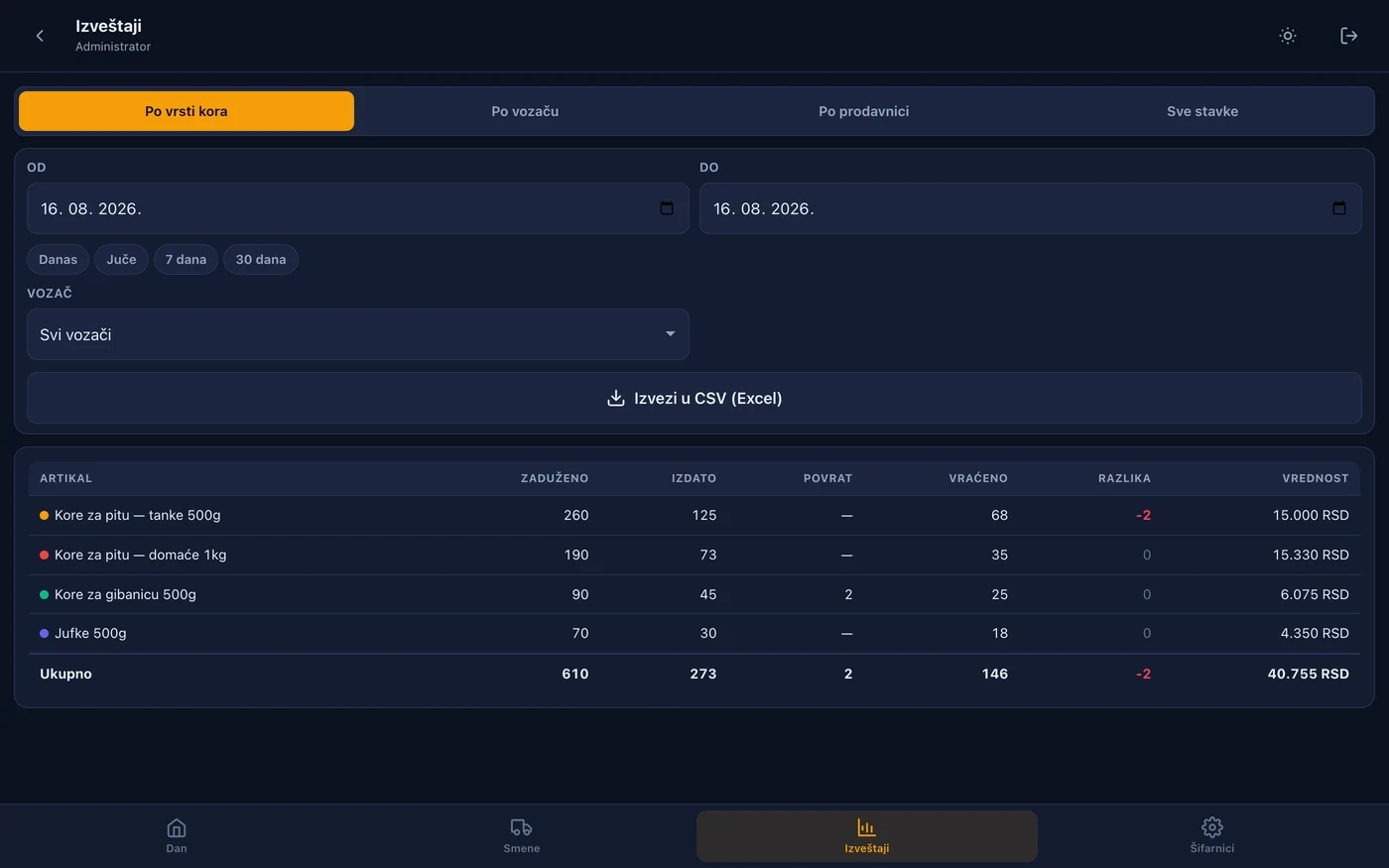
Distribution records from the warehouse to each store
Kore is a business web application for a pastry sheet producer and its distribution team. We organised the workflow around a driver's shift: collecting goods, delivering to stores and reconciling the remaining stock on return. Each entry belongs to a shift, a product type and, for deliveries, a store.
Drivers need a straightforward screen they can use in the field. Managers need an overview of the same records, with a way to inspect individual entries. We built separate views for these tasks, connected to a shared record of the distribution process.
What happens during a shift?
- Loading. The driver opens a shift and records the quantity collected for each product type. Additional loads can be recorded during the day.
- Delivery. The driver selects a store and records the quantities delivered, with a view of the stock still in the vehicle.
- Returns. Old goods collected from a store are recorded separately from usable stock returned to the warehouse.
- Closing. The remaining quantities are entered, and the application shows the difference between the recorded balance and returned stock.
The discrepancy is calculated when the shift closes. While deliveries are in progress, some stock is still with the driver and should not be treated as a final shortage. This business rule also shapes the reports.
Why use a web application on a phone?
The application opens in a browser and can be added to a phone's home screen. This approach suits an internal tool: employees use the agreed address without installing an app from a store. Screens focus on quantities, store selection and confirming an action.
The scanner uses the camera to read a product barcode, an individual item's serial code or a store's QR code. If the camera is unavailable, the code can be entered manually. Code recognition connects to the same quantity and delivery records.
When the connection drops, entries stay on the phone awaiting upload. Synchronisation sends them when connectivity returns, while repeated-request detection prevents a retried submission from creating a duplicate record. For similar field work, the choice between browser access and a mobile application depends on employees' devices and daily tasks.
Management works from the same records
The administration area includes shift overviews, reports by product, driver and store, and a detailed entry list. Records can be exported to CSV for further processing. Reference lists bring products, stores and drivers together.
The screen shown illustrates the report structure; its values are not evidence of business outcomes. The specific contribution of the application is a shared recording workflow: field entries and discrepancy checks use the same data.
Where does a similar approach fit?
This type of web application suits clearly defined operational tasks that need to be connected: loading, delivery, returns and reconciliation. Custom software can follow a company's own rules instead of relying on disconnected spreadsheets.