
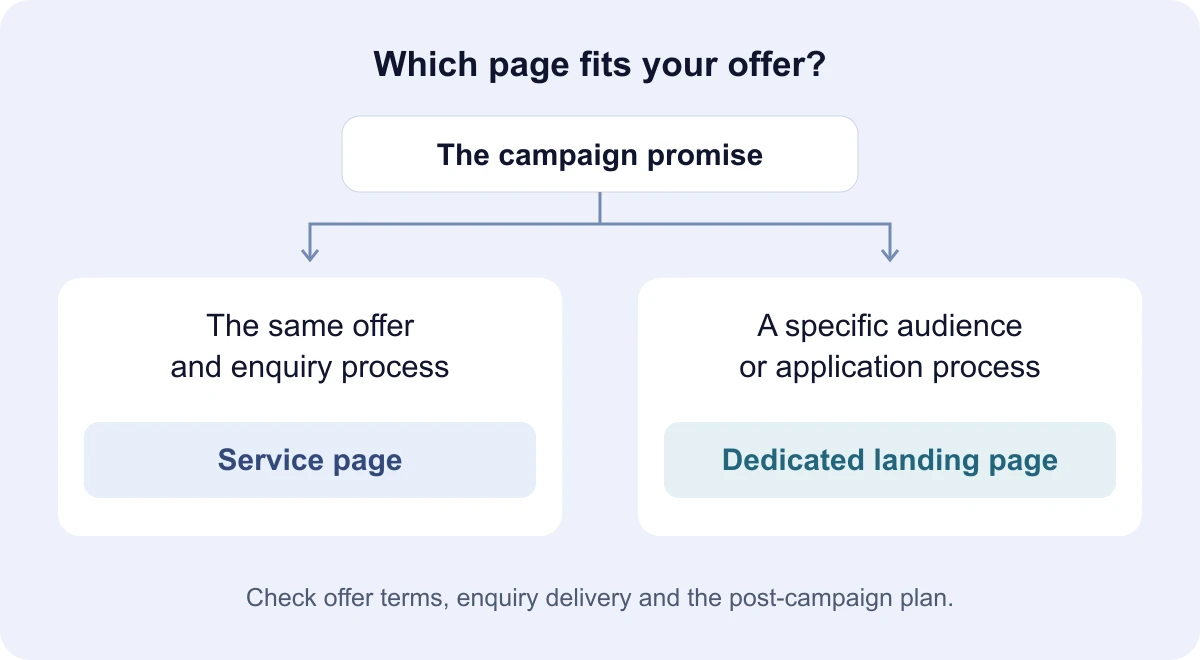
Landing page or service page: the choice depends on what you promise visitors and what you ask them to do. A dedicated landing page makes sense when a campaign introduces a different offer, audience or application process. If your existing service page already explains the same offer clearly and provides the right next step, consider improving it first.
A landing page is the page someone reaches through a particular link. In this comparison, we use the term for a dedicated campaign page. A service page usually describes a business's broader, ongoing offer. It can also serve as a campaign destination; each new source of visitors does not need its own URL.
Does the page deliver on the campaign's promise?
Place the campaign message beside your existing page. Is the promised service immediately recognisable? Can visitors check the scope, conditions and enquiry process without searching the rest of the website? If a campaign offers an inspection for a particular piece of equipment, a general description of every repair service may leave too many questions unanswered.
According to Google's landing page definition, relevant and useful information, ease of navigation and the expectations created by an ad contribute to the destination experience. Our recommendation is to begin the decision about a separate page with that match.
Scroll the table sideways to see all columns.
| Situation | What to consider first |
|---|---|
| The same service and terms, a different traffic source | The existing service page, with a review of its introduction and enquiry process. |
| A specific audience, scope or application process | A dedicated landing page that explains the difference. |
| A time-limited offer | A separate destination with a clear deadline and a plan for when the offer ends. |
| An unclear offer or a broken form | Fixing the existing content and enquiry delivery before creating another page. |
What does a landing page need to explain?
Visitors should understand who the offer is for, what they receive and what happens after they apply. Explain restrictions that could change their decision: service area, supported products, dates or required documents. An important condition should be visible before someone submits the form.
If you include a project or customer experience, choose evidence for the service you are offering. An image of a completed website does not demonstrate higher sales. An outcome claim needs a source and an explanation of what was measured. When you do not have that information, show the scope of the work delivered.
Keep the business name, contact information and privacy policy accessible. Adapt navigation to the visitor's task. Google specifically highlights useful navigation to the content people expect. That supports reviewing the paths visitors need rather than automatically removing every link from a campaign page.
How would you decide for a seasonal service?
Imagine a company that maintains commercial coffee machines. Its service page covers routine maintenance and repairs, while a campaign promotes inspections before seasonal venues reopen. This is a fictional example to compare the two page types, with no claim about achieved results.
If the inspection is part of the regular service and uses the same booking process, the existing page could gain a section about it and a relevant campaign link. Visitors would find the inspection scope and arrangements for a visit in that section.
If the inspection is restricted to particular machines and premises, and an estimate requires the number of units and an opening date, a dedicated page could explain those conditions more clearly. Its form would ask for the details needed to assess that work. The team handling enquiries must be able to see which offer each application concerns.
Should a new landing page appear in Google Search?
Decide whether its content is useful to someone who has not seen the campaign. An ongoing, distinct offer may deserve its own page for organic search. A temporary variation of existing content needs a separate review of indexing and its relationship to the main page.
Google's canonical URL guidance concerns duplicate or very similar pages. A canonical is a signal for choosing the preferred version. Do not automatically point a distinct service at a different offer just because both belong to the same business.
Before publication, record the new URL's purpose, its relationship to the service page and the plan for when the campaign ends. This helps prevent an expired promotion from remaining on the website as a current offer. A dedicated page does not guarantee a higher search position.
How do you assess whether the chosen destination works?
Define the intended result beforehand: for example, a received enquiry with enough information to assess whether the work fits your service. A button click, a form start and a successfully received enquiry should be separate measurement actions. A submitted enquiry is not yet an agreed project.
Check that the offer context and agreed traffic-source details accompany the enquiry, in line with the visitor's consent choices. Record the change date and review relevant visits and the quality of incoming messages. One enquiry, or a comparison of two pages attracting entirely different audiences, is not enough to declare one version more successful.
If the problem affects several pages, begin with why a website gets visitors but no enquiries. That guide covers the broader checks of audience, offer and message delivery. The decision here is narrower: which destination explains a particular offer most clearly?
What should you check before launch?
- On a phone, open the exact link visitors will receive, including its campaign parameters.
- Compare the campaign promise with the introduction, conditions and invitation to apply.
- Send a clearly labelled test and check receipt, confirmation and offer context with the person who handles enquiries.
- Agree who updates the content and what happens to the page when the offer ends.
- Check that the privacy notice and necessary contact details remain accessible.
What should you send us for a development estimate?
Send your current website URL, the offer text and an example of the enquiry you want to receive. Explain any differences in audience or conditions and who will handle applications. We can then assess whether a page update is sufficient or whether you need a separate destination, content and a different form.
See our website development service for the scope of work and examples. To discuss a particular offer, request a free project estimate and mention that you are considering a landing page.