
Website development for manufacturing companies should help buyers judge whether you can make the part or product they need. State capacity with its units and operating conditions, explain the manufacturing processes, and show your contribution to completed work. Give buyers a clear route from each relevant page to a technical enquiry.
Before designing the pages, collect the questions your sales team answers before preparing a quote. If conversations repeatedly return to material, dimensions or batch size, those explanations belong on the website. When planning website development, start with one service and one approved example of your work. Use them to check the content structure before preparing the remaining pages.
How should you separate products from contract manufacturing?
A buyer choosing a finished product needs the right model and its variants. A contract manufacturing buyer needs to know whether you can turn a drawing into a part. If you offer both, give them separate navigation labels that your customers recognise, such as “Products” and “Manufacturing services”.
A product page should explain its purpose, dimensions and available versions. A process page should describe the materials you accept, the work you perform and the information needed for an assessment. For a catalogue with several models, our guide to B2B catalogues and quote requests covers linking products to enquiries. A manufacturing page also needs to explain the limits of the process you offer.
A separate URL is useful when buyers have different questions or supply different documentation for that service. Avoid creating a page for every machine name if each page would contain the same description. You can explain related operations together and link to relevant completed work.
How do you describe capacity without promising the wrong deadline?
Give each capacity figure a unit, a time period and the type of work it describes. For a part count, specify the product or repeatable operation it applies to. For processing dimensions, explain whether the measurement refers to the input material or the finished part. Describe material and complexity conditions alongside any figure they affect.
Technical capability and current availability mean different things. Equipment may be able to handle a part, while the delivery date for a new order depends on the production schedule and further checks. Publish verified processing limits and agree the schedule after reviewing the request.
For each public figure, keep an internal record of the source, check date and person who confirms it. When equipment or a process changes, that record shows which pages need updating. Keep unconfirmed values out of the public specification.
What should you explain alongside equipment and workshop photographs?
Add a description of the operation you perform to the machine name and model. State the materials involved and where that operation fits into the rest of the job. If a partner performs one stage, identify their role. Buyers should understand the work they are discussing with you and where additional coordination is needed.
A wide workshop photograph shows the space. A close view of processing or inspection can explain a particular stage. Before publication, check visible screens, job sheets and customers’ parts. For work you cannot show publicly, use your own sample part or another approved illustration.
An informative photograph needs a short description of what it contributes to the page. The W3C alt text decision tree relates the description to the image’s purpose: informative images need a suitable text alternative, while purely decorative images may have an empty alt attribute. Also provide technical information needed for a decision as readable text beside the photograph.
How should you present completed work and certificates?
For a project reference, describe the task, your part in manufacturing and what you delivered to the customer. Include the material or process where you have permission to publish it. If the customer’s name is confidential, use an approved description of the industry and job. Check permission for the photograph and customer logo separately.
For a certificate, give the holder, standard, scope, issuer and validity period as recorded in the document. Do not extend its stated scope to another location or process. Help visitors verify what the claim covers by providing a permitted document or verification link where available.
ISO explains that external certification bodies perform certification and that ISO does not issue certificates itself. Use the actual issuer’s name from your document. Check the issuer’s rules before adding its certification mark to the website.
What does a technical enquiry for a small enclosure batch look like?
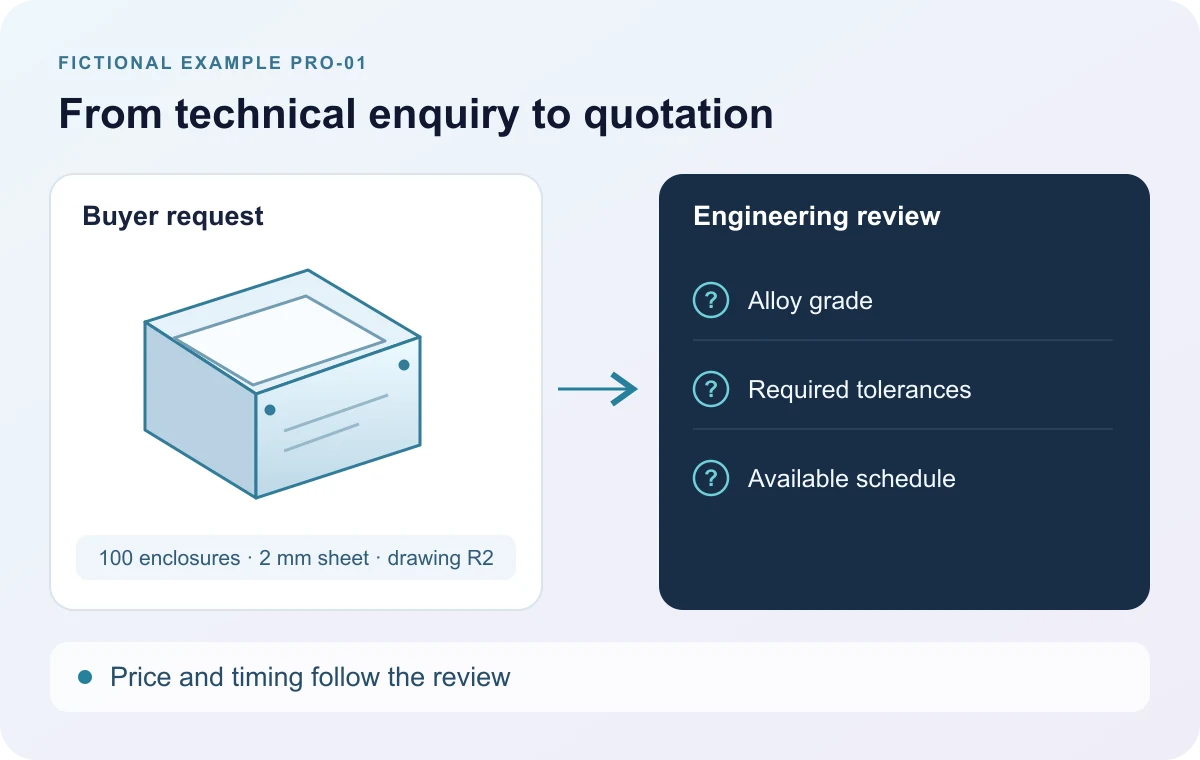
Imagine a buyer requesting 100 metal enclosures from a company offering sheet metal processing. PRO-01 is a fictional example; its values do not describe our company’s capacity or a client project. The buyer moves from a process page to a comparable part example and sends the initial documentation.
Scroll the table sideways to see all columns.
| Item | Initial buyer request | Check before quoting |
|---|---|---|
| Part and quantity | 100 enclosures of the same version. | Confirm whether the quantity covers complete assemblies or individual parts. |
| Material | Aluminium sheet, 2 mm thick. | The alloy grade is missing; the engineer requests it before confirming the process. |
| Documentation | An enclosure drawing marked revision R2. | Confirm that R2 is current and includes the dimensions needed for assessment. |
| Tolerances | Not specified in the initial description. | Clarify the requirements with the buyer before accepting the work. |
| Finishing | The buyer asks for a recommendation. | Agree the intended use, appearance and division of work between the company and any partner. |
| Timing | The buyer gives a preferred date. | Production checks availability; sending an enquiry does not confirm a deadline. |
The R2 reference should remain visible in the conversation accompanying the enquiry. If the buyer later sends R3, the team needs to know which version supports its quote. Explain how buyers submit updates and which channel they use for documentation. Manufacturing approval remains part of the agreement with the production team.
Which fields should a technical enquiry form include?
Alongside contact details, ask for a description of the part, quantity and documents needed for an initial review. Show units beside dimensions and thickness. Let buyers indicate what they do not yet know, such as the finishing choice, rather than forcing an inaccurate selection to continue.
For attachments, state the formats and sizes the system actually accepts. If documents are supplied after a conversation, explain that process before submission. Confidential drawings may need prior agreement and another transfer channel; a public contact form should not imply unrestricted acceptance of every material.
The W3C guidance on form instructions recommends clear required and optional fields, expected formats and relevant explanations. A placeholder that disappears during entry does not replace a field label. Error messages should explain what the buyer can correct.
Confirm receipt only after the system accepts the message. Explain who reviews the request and when price and timing are agreed. If sales staff and an engineer both handle enquiries, decide who communicates with the buyer and who covers their absence.
Who approves changes to capacity and technical content?
Someone in production should approve technical values, while sales checks that the page answers buyers’ questions. In the content management system, you can separate fields for material, processing limits, photographs and timing notes. Agree whether an editor can save a draft or also publish changes.
For multiple languages, keep process names and units consistent. When a process is withdrawn or a document expires, update the translations too. Our guide to maintaining a multilingual website covers ownership of those changes. Add a check date to information where currency affects its meaning.
What should you check before launching a manufacturing website?
Ask a colleague in purchasing or sales to find the right process and prepare a request using the website. Record where they need additional explanations. The following scenarios are proposed checks, not results from a completed client test.
- The buyer starts with their part, finds a process and can distinguish the company’s own work from a partner’s contribution.
- The public specification makes clear which part type and unit each capacity value refers to.
- For PRO-01, the buyer can identify the drawing revision and indicate that alloy or tolerances still need clarification.
- On a phone, technical details remain readable and the enquiry is reachable. Keyboard users can reach each field and find a clear error message.
- In a controlled environment, check a valid enquiry, a rejected attachment format and a server error. The receipt message matches the actual outcome.
- A changed capability or withdrawn certificate is no longer presented as current in either language.
After launch, record which questions the engineer still needs to repeat and which requests the company can accept. Keep contact clicks separate from received and qualified enquiries. Improve the content buyers need to take the next step.
What should you prepare for a development estimate?
Prepare a list of products and manufacturing services, confirmed technical values and material for one permitted project reference. Add an existing enquiry with confidential details removed, the required languages and the person who will maintain the content. In your website brief, record what still needs collecting.
Send this overview for a manufacturing website estimate. It gives us a basis to agree the structure, technical enquiry process and scope of the first version. Compare costs against that scope; our website cost guide separates development, maintenance and other first-year costs.