
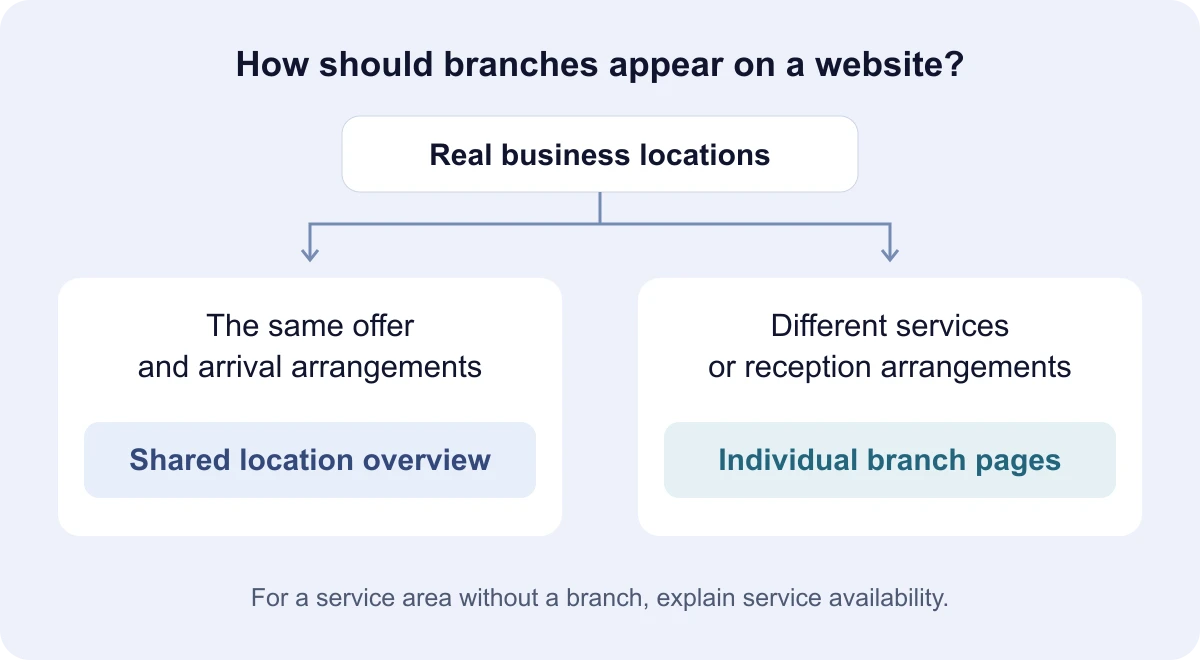
Website development for a business with multiple locations starts with what customers need to know about each branch. A separate page makes sense when services, opening hours, booking or arrival instructions differ. If several addresses share the same offer and contact arrangements, a clear combined contact page may be enough.
The number of branches does not automatically determine the number of pages. A visitor might need a shop for collection, a service centre that accepts their equipment or an office for an agreed meeting. The website should help them choose the right destination before calling or setting off.
When is one contact page enough?
List the address, contact details and opening hours for every real location. Add the services available there and any arrival arrangements. Ask staff which questions keep coming up on the phone: do customers miss the entrance, arrive outside reception hours or expect a service that the branch does not provide?
Scroll the table sideways to see all columns.
| Situation | Suggested website structure |
|---|---|
| The same offer and contact arrangements at several addresses | One contact page with a clearly labelled, separate section for each branch. |
| Different services, appointments or reception arrangements | A location overview and separate pages explaining the differences and linking to the right contact. |
| A warehouse that customers do not visit | Explain its role where relevant; do not present it as a shop. |
| A service area without a branch | Explain availability and site visits without inventing a local office address. |
Check what changes during the week, too. A branch may have different hours for sales and equipment drop-off. Combining both into one opening time can still leave customers unsure when to arrive.
What belongs on a branch page?
Start with a name visitors understand and a precise address. Make contact details and reception hours easy to find. Explain which services are available at that particular branch, whether an appointment is required and what customers should bring. Mention a side-street entrance, floor or collection point when it affects the visit.
A photograph of the actual entrance can help someone visiting for the first time. Images of different premises should show the corresponding branches. Give each a short description of what is visible, without listing cities or services that the photograph does not show.
Check the map link on a phone: it should lead to that location. If a shared switchboard answers calls, say so beside the number. Keep company-wide terms in one place and link to them from branch pages; put location-specific arrangements beside the relevant address.
A fictional example: sales and repairs at different addresses
Imagine a business that sells equipment at one address and accepts repairs at another. Someone bringing a broken device needs the service address and drop-off hours immediately. The sales page should link clearly to repairs so visitors do not take equipment to a shop that cannot accept it.
The service page can explain what to bring and how to open a repair request. The sales page can describe viewing equipment and collecting orders. A shared location overview lets visitors choose by task, without repeating the entire company history on both pages.
If another shop opens with the same offer, first collect its contact details and arrival instructions. Expand its own page when there is further local information that helps visitors. This is a fictional example for planning a website structure.
How should the website connect to Google Business Profile?
Google requires accurate real-world location details and customer-facing opening hours. A rented mailing address where the business does not operate is not eligible for a profile. The business representation guidelines explain the conditions and exceptions.
For a branch with its own page, check that its profile links to the appropriate URL. Compare the name, address, phone and opening hours with the website. If a schedule has not been confirmed, get it from the responsible person before publishing it.
Our contact and office overview includes Partizanske avijacije 50 and Sredačka 2. A combined overview lets visitors see both addresses in one place. This arrangement is an option for businesses without enough distinct information for two detailed pages.
Does a page for every city help local SEO?
Replacing a city name alone gives visitors no new answer. Google's doorway abuse policy includes similar regional pages that funnel people to the same destination. That risk is a reason to assess each proposed page by its actual purpose.
Remove the city name from a draft and read what remains. Does the visitor learn where to go, which service is available and whom to contact? General paragraphs about the city cannot supply those details. For on-site services, explain coverage and how a visit is arranged without presenting a service area as an office.
LocalBusiness structured data can describe real branches technically. Google recommends defining each location separately. Entries should match visible information; the markup guarantees neither search features nor positions.
Who updates the details and checks enquiries?
Choose someone to confirm each branch's information, with a replacement during their absence. A central editor can make every change but needs to know who reports a move, a new service or a temporary closure. A CMS for editing website content can hold shared details once and display them wherever needed.
A branch enquiry form should save the selected location with the request and send it to the agreed team. Test changing the selection and check that the confirmation message makes the destination clear. Then check the contact page, footer and map for an outdated address.
What should you prepare for website development?
Prepare a list of locations with confirmed details, entrance photographs and one typical customer task for each branch. Identify information confirmed by the local team and information shared across the company. Check the common pages against our guide to business website structure.
For a website with multiple business locations, send that list with a project estimate request. The differences will help us suggest what to keep together and which branches need a separate page.